

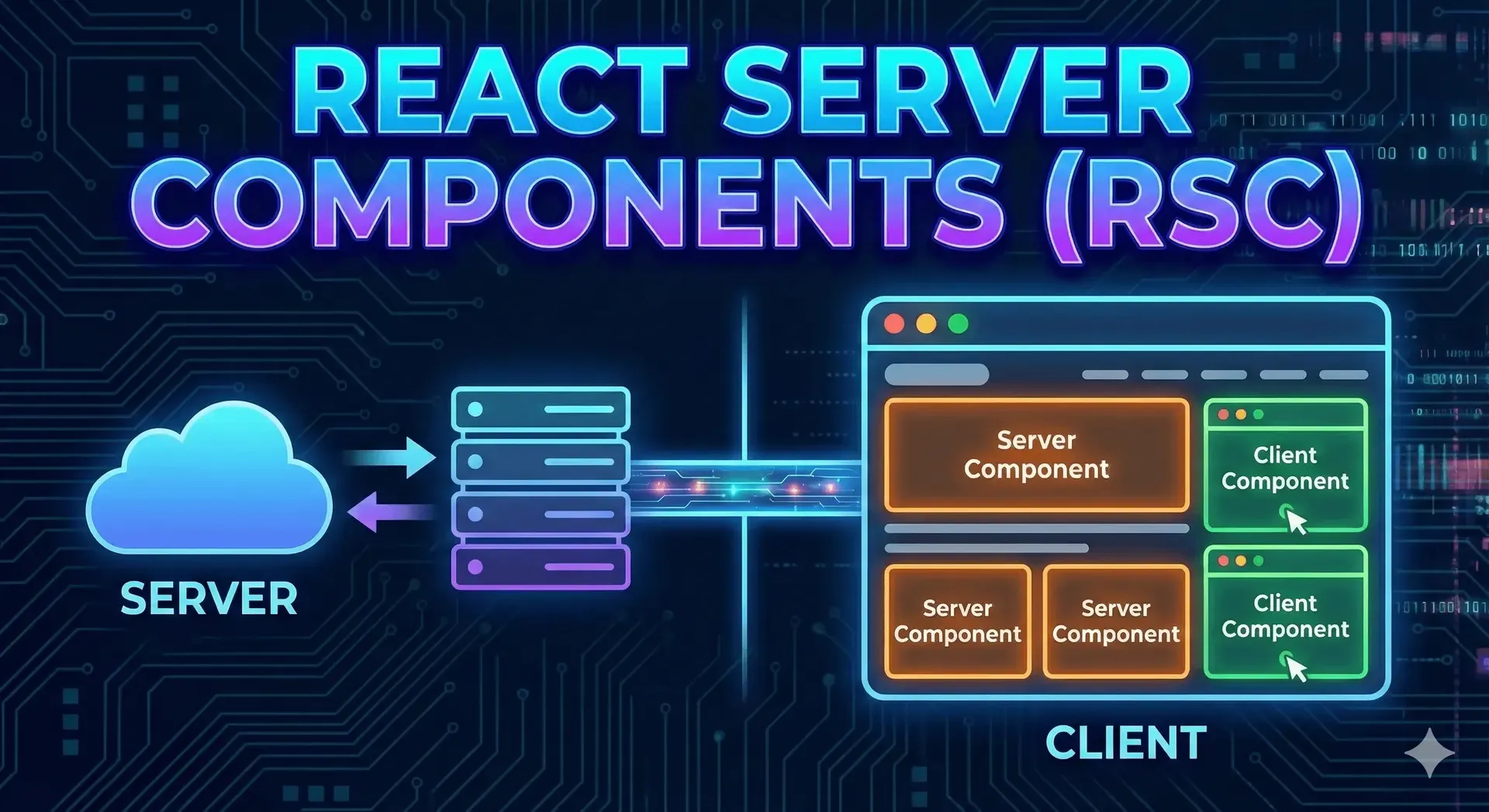
This guide is also helpful if you're searching for a React Server Components deep dive, want to learn RSC from scratch, or want clarity on how React Server Components in Next.js actually work in real-world applications.
Today, RSC is becoming even more relevant as developers search for updated information, especially around React Server Components 2026 and how the feature is evolving.
What Are React Server Components?
React Server Components are React components that run on the server instead of the browser. This article explains RSC from scratch, making it easier for beginners to understand why server-first React is becoming so important.
React Server Components Deep Dive
If you're looking for a React Server Components deep dive, the core idea is understanding how RSC changes the rendering model of React.
A deeper look includes:
- How the RSC protocol streams UI instructions
- How the server and client share responsibilities
- How React decides what to render where
- How hydration works alongside server-rendered payloads
This deep dive perspective makes it clearer why RSC is not just a new API but a new architecture.
React Server Components Example
Below is an example of using React Server Components in Next.js — a perfect illustration if you're learning React Server Components from scratch.
export default async function ProductsPage() {
  const products = await fetch("https://api.example.com/products").then(res => res.json());

  return (
    <div>
      <h1>Products</h1>
      {products.map(p => <p key={p.id}>{p.name}</p>)}
    </div>
  );
}
Why this is a Server Component:
- It runs on the server
- It can fetch data directly
- No JavaScript from this component reaches the browser
- The browser receives only the rendered UI
Server Components vs Client Components
React now splits components into two categories:
Server Components
- Run on the server
- Do not ship JavaScript to the client
- Best for data fetching and non-interactive UI
Client Components
Client Components require the following directive:
use client
Example:
"use client";
export default function Counter() {
  const [count, setCount] = useState(0);
  return <button onClick={() => setCount(count + 1)}>{count}</button>;
}
Use Client Components when you need:
- User interactions
- Forms
- State and hooks
- Event listeners
- Animations
How the RSC Protocol Works
Understanding the React Flight protocol is essential if you're learning React Server Components from scratch or want a deeper technical understanding.
1: "Hello World"
2: ["$", "h1", null, { "children": [1] }]
3: ["$", "div", null, { "children": [2] }]
These instructions tell React how to build the UI on the client side, without requiring full component code.
This approach makes applications faster and reduces the amount of JavaScript shipped to the browser.
How React Server Components Work: Step-by-Step
- The server executes the component
- React generates an RSC payload containing UI instructions
- The browser receives the lightweight RSC payload
- React reconstructs the UI in the browser
- Client Components hydrate and handle interactivity
This hybrid model blends server rendering and client rendering seamlessly.
Benefits of React Server Components
1. Reduced JavaScript Bundle Size
Server components never get shipped to the browser.
2. Faster Page Loads
Less JavaScript means better performance, especially on slower devices.
3. Cleaner Architecture
Server logic stays on the server, making code easier to maintain.
4. Better SEO
More HTML is generated server-side, improving discoverability.
5. Direct Access to Server Resources
RSC can talk directly to databases, APIs, or files without extra API routes.
These benefits explain why many frameworks are adopting RSC and why developers searching for React Server Components future see RSC as the next logical evolution of React.
Limitations of RSC
While RSC is powerful, its limitations help shape the future of React Server Components, including upcoming improvements in performance, compatibility, and debugging support.
Additionally, security must be considered, especially with incidents like CVE-2025-66478 — a notable React server components vulnerability that impacted RSC implementations in several frameworks.
NOTE- On 11th December 2025 two additional vulnerabilities have been found in next js
-
Denial of Service: CVE-2025-55184: A malicious request to app router routes during deserialization request can be stuck in infinete loop and future request can not be served. Next js keep this in criticle category.
-
Source Code Exposure: CVE-2025-55183: A malicious request can trick server and server can expose buisness logic and other secret var present on server.
Next js suggested to user to update old versions to new stable version. Its is very straightforward just run below command in project folder.
npx fix-react2shell-next
When Should You Use React Server Components?
Use RSC when:
- Your UI contains heavy data fetching
- You want to improve performance without extra complexity
- You aim to reduce your JavaScript bundle
- You build with Next.js App Router
- You want a clean server-driven architecture
The Future of React Server Components
React Server Components Future: What’s Coming Next?
The future of React Server Components is incredibly promising.
Here’s what we expect:
- More frameworks adopting the RSC architecture
- Better tooling around debugging and profiling
- Simplified interop between Server and Client Components
- Reduced constraints around third-party libraries
- Improved performance in streaming and caching
- Security patches and more standardized RSC protocol handling
With Next.js pushing server-first development, the React Server Components future will likely define how frontend apps are built through 2026 and beyond.
No surprise that developers are already searching for React Server Components 2026, expecting major improvements aligned with React 19 and future framework updates.st a feature; they represent a significant shift toward server-first architecture in frontend development.
Conclusion
Whether you're exploring React Server Components from scratch, diving deeper into the architecture, or trying to understand how React Server Components in Next.js are transforming modern development, RSC represents a massive step forward.
Server-first React is more than just a trend — it is shaping the future of how we build web applications.
This React Server Components deep dive should give you clarity and confidence as you adopt RSC in your upcoming projects.

Written by
Deepak Verma
I'm Deepak Verma, I transform complex problems into elegant, efficient, and scalable solutions. With over 4+ years of experience, I build modern web applications that deliver exceptional user experiences.


